What’s the best that can happen in 9 Weeks?
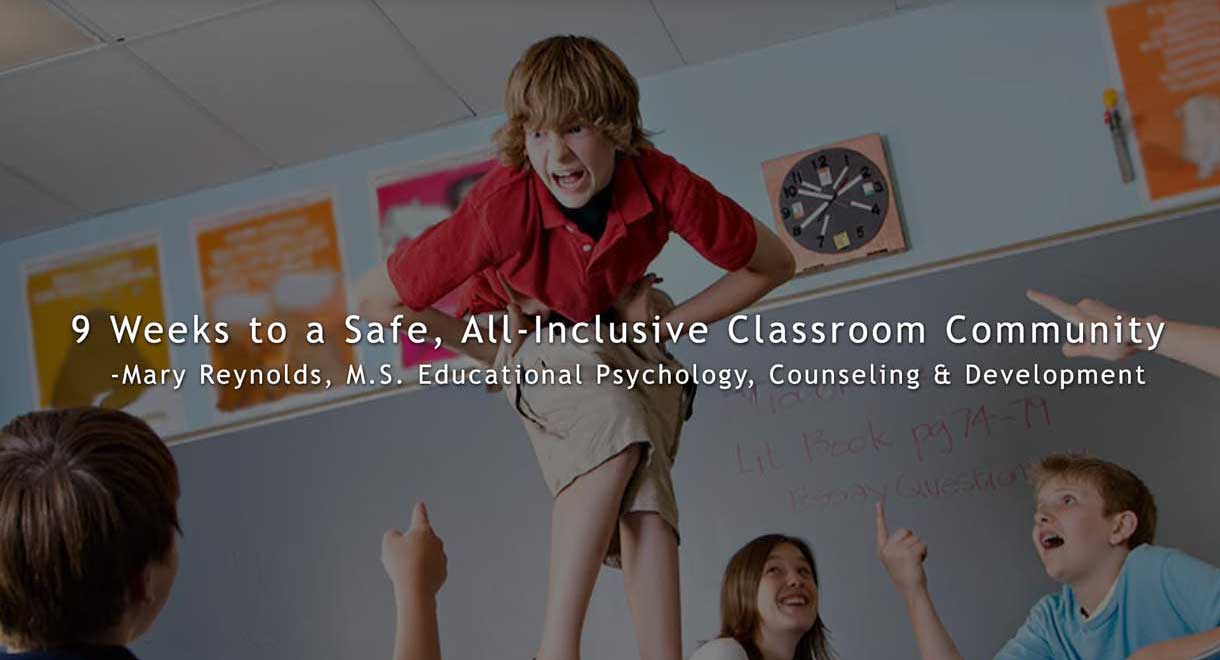
I’m Mary Reynolds, and the photo above is a depiction of the first day of my 7th year of teaching.
When I walked into my classroom of 55-65% behaviorally at-risk students and saw one of them on top of his desk acting like a monkey I made a firm decision, “I am going to make this their best year ever!”
Having grown up as my parent’s designated “problem child,” I had vowed I would come up with much better ways of reaching kids than by using the hurtful, harmful tactics that were used on me, and that’s exactly what I did.
So when I walked in and saw this, I was determined to turn all of this big, outrageous behavior around, once and for all!
This was 40 years ago, in a mining community with a very transient population, where liquor stores had drive-up windows where you could get an alcoholic drink to go (still can) and where kids with disruptive behaviors was the daily norm.
Even though these kinds of problems seem to have only reached suburban schools in recent decades, it’s always been highly problematic in transient and urban schools.
I know because I’ve taught, coached sports and counseled in rural, transient, urban and suburban schools, so I’ve pretty much seen and experienced a lot.
In one of the school districts I worked in, there were violent gangs walking the streets of that community with crowbars and guns, big scary fights outside our home on Saturday nights, and one of my traumatized students murdered his abusive father.
There was daily substance abuse on campus, a suicide epidemic, babies being born in school bathrooms.
And this is not a complete list.
I’m not trying to impress you, but rather to impress upon you that I’ve been in the trenches.
The energetics of the classroom as a caring, compassionate, empowering community is the cornerstone you need to be able to help today’s students.
You don’t need to wait until you earn a special degree.
You simply need 9 weeks to reach and teach everyone how best to get to the heart of any problem with conversation starter movies and weekly thought expanding group activities.
Teach them how to talk so others will listen with field-tested, open-ended discussion questions designed to get students talking to their peers and adults constructively!
In 9 weeks we went from this …
…to this!
a self-regulating
self-advocating
self-governing
safe, all-inclusive
high-performing group
What’s the best that can happen in 9 Weeks?
I’m Mary Reynolds, and the photo above is a depiction of the first day of my 7th year of teaching.
When I walked into my classroom of 55-65% behaviorally at-risk students and saw one of them on top of his desk acting like a monkey I made a firm decision, “I am going to make this their best year ever!”
Having grown up as my parent’s designated “problem child,” I had vowed I would come up with much better ways of reaching kids than by using the hurtful, harmful tactics that were used on me, and that’s exactly what I did.
So when I walked in and saw this, I was determined to turn all of this big, outrageous behavior around, once and for all!
This was 40 years ago, in a mining community with a very transient population, where liquor stores had drive-up windows where you could get an alcoholic drink to go (still can) and where kids with disruptive behaviors was the daily norm.
Even though these kinds of problems seem to have only reached suburban schools in recent decades, it’s always been highly problematic in transient and urban schools.
I know because I’ve taught, coached sports and counseled in rural, transient, urban and suburban schools, so I’ve pretty much seen and experienced a lot.
In one of the school districts I worked in, there were violent gangs walking the streets of that community with crowbars and guns, big scary fights outside our home on Saturday nights, and one of my traumatized students murdered his abusive father.
There was daily substance abuse on campus, a suicide epidemic, babies being born in school bathrooms.
And this is not a complete list.
I’m not trying to impress you, but rather to impress upon you that I’ve been in the trenches.
The energetics of the classroom as a caring, compassionate, empowering community is the cornerstone you need to be able to help today’s students.
You don’t need to wait until you earn a special degree.
You simply need 9 weeks to reach and teach everyone how best to get to the heart of any problem with conversation starter movies and weekly thought expanding group activities.
Teach them how to talk so others will listen with field-tested, open-ended discussion questions designed to get students talking to their peers and adults constructively!

In 9 weeks we went from this …
…to this!
a self-regulating
self-advocating
self-governing
safe, all-inclusive
high-performing group
What’s the best that can happen in 9 Weeks?
I’m Mary Reynolds, and the photo above is a depiction of the first day of my 7th year of teaching.
When I walked into my classroom of 55-65% behaviorally at-risk students and saw one of them on top of his desk acting like a monkey I made a firm decision, “I am going to make this their best year ever!”
Having grown up as my parent’s designated “problem child,” I had vowed I would come up with much better ways of reaching kids than by using the hurtful, harmful tactics that were used on me, and that’s exactly what I did.
So when I walked in and saw this, I was determined to turn all of this big, outrageous behavior around, once and for all!
This was 40 years ago, in a mining community with a very transient population, where liquor stores had drive-up windows where you could get an alcoholic drink to go (still can) and where kids with disruptive behaviors was the daily norm.
Even though these kinds of problems seem to have only reached suburban schools in recent decades, it’s always been highly problematic in transient and urban schools.
I know because I’ve taught, coached sports and counseled in rural, transient, urban and suburban schools, so I’ve pretty much seen and experienced a lot.
In one of the school districts I worked in, there were violent gangs walking the streets of that community with crowbars and guns, big scary fights outside our home on Saturday nights, and one of my traumatized students murdered his abusive father.
There was daily substance abuse on campus, a suicide epidemic, babies being born in school bathrooms.
And this is not a complete list.
I’m not trying to impress you, but rather to impress upon you that I’ve been in the trenches.
The energetics of the classroom as a caring, compassionate, empowering community is the cornerstone you need to be able to help today’s students.
You don’t need to wait until you earn a special degree.
You simply need 9 weeks to reach and teach everyone how best to get to the heart of any problem with conversation starter movies and weekly thought expanding group activities.
Teach them how to talk so others will listen with field-tested, open-ended discussion questions designed to get students talking to their peers and adults constructively!
In 9 weeks we went from this …
…to this!
a self-regulating
self-advocating
self-governing
safe, all-inclusive
high-performing group
Watch “The Lost Cause Kid” movie to see how these students’ lives were transformed!
When you compassionately address what’s really going on between students rigorously for 9‑Weeks with my 30 Second “What, If, When” Method, you eventually put a complete end to de‑energizing behaviors and ultimately those big, scary, hard to recover from room clears.
When you simply follow this “done for you micro-dose curriculum” you will be easily able to:
Stop fearing students’ unskillful behavior aimed at you and/or their classmates.
Start modeling confident, safe, explorative conversations with my 30 Second “What, If, When” (WIW) Method.
Join the many thousands of educators around the world who have intentionally and deliberately set the tone for their classrooms – for good!
Become highly productive academically – both socially and emotionally!
Make A Difference NOW!
Get full access to this 9‑Week Synergistic Community Building Curriculum, so you can have your Best Year ever!
Watch “The Lost Cause Kid” movie to see how these students’ lives were transformed!
When you compassionately address what’s really going on between students rigorously for 9‑Weeks with my 30 Second “What, If, When” Method, you eventually put a complete end to de‑energizing behaviors and ultimately those big, scary, hard to recover from room clears.
When you simply follow this “done for you micro-dose curriculum” you will be easily able to:
Stop fearing students’ unskillful behavior aimed at you and/or their classmates.
Start modeling confident, safe, explorative conversations with my 30 Second “What, If, When” (WIW) Method.
Join the many thousands of educators around the world who have intentionally and deliberately set the tone for their classrooms – for good!
Become highly productive academically – both socially and emotionally!
Make A Difference NOW!
Get full access to this 9‑Week Synergistic, Micro‑Dose Curriculum, so you can have your Best School Year ever!
Every school year, I felt that the first nine weeks of school set the stage for how the entire year would go.
I knew—down to my toes—that if my student’s social-emotional needs were all dealt with, they would be highly functional the rest of the school year, and classroom life would be good.
In working with parents, I told them to be laser-focused on the things I wanted them to accomplish, with an end-goal of just nine weeks.
It takes only nine! Any nine weeks will do. You begin when you begin.
Through teaching children, educators and parents how to create a compassionate community and/or home environment, we dramatically raised emotional intelligence.
How did I do this?
My goal was simple.
I placed the children’s social-emotional needs first—above my concern about making it through X number of pages a week.
Raising their social-emotional intelligence –with structured, field-tested group engagement – dramatically improved their mind’s ability to focus and function academically AND become socially resilient.
Every single time an emotional situation played out in the classroom, lunchroom or playground, we had an open discussion – using my WIW Method – to quickly get to the heart of the problem and get back to work.
The key is to stop expelling, excluding, or abandoning kids and start asking WIW questions.
Everybody in the environment is involved and you will achieve an exponential reach. Soon you will see your students modeling a mini-me version of you!
And guess what? You will feel energized and soul-fulfilled at the end of every day – leaving you with time to have a life once you head home!
Use your Compassion SuperPower and be amazed at how quickly everything gets better.
Yes! You’ll finally be able to:
How cool is that?
Once you get this, you’ll have the tools, strategies, and ability to…
Stop talking, start listening.
Retrain your brain to resist fixing!
Group conversations, when done compassionately, will give individual students the opportunity to relate with other students experiencing similar thoughts, feelings and issues, creating a feeling of universality and connection.
They also create a sense of hope and unity as they watch each other feel better and do better.
Every school year, I felt that the first nine weeks of school set the stage for how the entire year would go.
I knew—down to my toes—that if my student’s social-emotional needs were all dealt with, they would be highly functional the rest of the school year, and classroom life would be good.
In working with parents, I told them to be laser-focused on the things I wanted them to accomplish, with an end-goal of just nine weeks.
It takes only nine! Any nine weeks will do. You begin when you begin.
Through teaching children, educators and parents how to create a compassionate community and/or home environment, we dramatically raised emotional intelligence.
How did I do this?
My goal was simple.
I placed the children’s social-emotional needs first—above my concern about making it through X number of pages a week.
Raising their social-emotional intelligence –with structured, field-tested group engagement – dramatically improved their mind’s ability to focus and function academically AND become socially resilient.
Every single time an emotional situation played out in the classroom, lunchroom or playground, we had an open discussion – using my WIW Method – to quickly get to the heart of the problem and get back to work.
The key is to stop expelling, excluding, or abandoning kids and start asking WIW questions.
Everybody in the environment is involved and you will achieve an exponential reach. Soon you will see your students modeling a mini-me version of you!
And guess what? You will feel energized and soul-fulfilled at the end of every day – leaving you with time to have a life once you head home!
Use your Compassion SuperPower and be amazed at how quickly everything gets better.
Yes! You’ll finally be able to:
How cool is that?
Once you get this, you’ll have the tools, strategies, and ability to…
Stop talking, start listening.
Retrain your brain to resist fixing!
Group conversations, when done compassionately, will give individual students the opportunity to relate with other students experiencing similar thoughts, feelings and issues, creating a feeling of universality and connection.
They also create a sense of hope and unity as they watch each other feel better and do better.
Every school year, I felt that the first nine weeks of school set the stage for how the entire year would go.
I knew—down to my toes—that if my student’s social-emotional needs were all dealt with, they would be highly functional the rest of the school year, and classroom life would be good.
In working with parents, I told them to be laser-focused on the things I wanted them to accomplish, with an end-goal of just nine weeks.
It takes only nine! Any nine weeks will do. You begin when you begin.
Through teaching children, educators and parents how to create a compassionate community and/or home environment, we dramatically raised emotional intelligence.
How did I do this?
My goal was simple.
I placed the children’s social-emotional needs first—above my concern about making it through X number of pages a week.
Raising their social-emotional intelligence –with structured, field-tested group engagement – dramatically improved their mind’s ability to focus and function academically AND become socially resilient.
Every single time an emotional situation played out in the classroom, lunchroom or playground, we had an open discussion – using my WIW Method – to quickly get to the heart of the problem and get back to work.
The key is to stop expelling, excluding, or abandoning kids and start asking WIW questions.
Everybody in the environment is involved and you will achieve an exponential reach. Soon you will see your students modeling a mini-me version of you!
And guess what? You will feel energized and soul-fulfilled at the end of every day – leaving you with time to have a life once you head home!
Use your Compassion SuperPower and be amazed at how quickly everything gets better.
Yes! You’ll finally be able to:
How cool is that?
Once you get this, you’ll have the tools, strategies, and ability to…
Stop talking, start listening.
Retrain your brain to resist fixing!
Group conversations, when done compassionately, will give individual students the opportunity to relate with other students experiencing similar thoughts, feelings and issues, creating a feeling of universality and connection.
They also create a sense of hope and unity as they watch each other feel better and do better.
It’s as simple as [press play] Conversation Starter Movies and/or read aloud directions for a thought-provoking activity, then open it up with “done for you” questions that invite “I’m not the only one who thinks and feels this way” group discussion.
It is recommended to have a Make A Difference Monday Hour. Each week has a thought-provoking movie and/ or activity to keep constructive conversations going throughout the week.
The activities provided for this are fun and safe. You will see your students opening-up emotionally in new and unexpected ways.
The more you know, the more you see beyond their classroom personas and unskillful behavior the more you will be able to tap into their best selves!
A diverse, self-advocating, self-governing, all-inclusive, socially and emotionally safe, seen, heard, welcoming group of students functioning at the highest levels academically every year.
Students working together peacefully, productively and the classroom a hum of activity.
Check out the entire “9 Weeks to a Synergistic,
Make A Difference” Micro-Dose Curriculum…
NOTE: We no longer stock the blue ribbons shown in the movie and have switched to blue “I Make A Difference” wristbands, which people reportedly continue to enjoy wearing for years. To follow the guidelines for Week 4’s “Acknowledgment Ceremony,” we recommend ordering four wristbands for each student: one to wear for themselves and three to go out in the world to acknowledge others with. (Available at checkout)
It’s as simple as [press play] Conversation Starter Movies and/or read aloud directions for a thought-provoking activity, then open it up with “done for you” questions that invite “I’m not the only one who thinks and feels this way” group discussion.
It is recommended to have a Make A Difference Monday Hour. Each week has a thought-provoking movie and/ or activity to keep constructive conversations going throughout the week.
The activities provided for this are fun and safe. You will see your students opening-up emotionally in new and unexpected ways.
The more you know, the more you see beyond their classroom personas and unskillful behavior the more you will be able to tap into their best selves!
A diverse, self-advocating, self-governing, all-inclusive, socially and emotionally safe, seen, heard, welcoming group of students functioning at the highest levels academically every year.
Students working together peacefully, productively and the classroom a hum of activity.
Check out the entire “9 Weeks to a Synergistic,
Make A Difference” Micro-Dose Curriculum…
NOTE: We no longer stock the blue ribbons shown in the movie and have switched to blue “I Make A Difference” wristbands, which people reportedly continue to enjoy wearing for years. To follow the guidelines for Week 4’s “Acknowledgment Ceremony,” we recommend ordering four wristbands for each student: one to wear for themselves and three to go out in the world to acknowledge others with. (Available at checkout)
It’s as simple as [press play] Conversation Starter Movies and/or read aloud directions for a thought-provoking activity, then open it up with “done for you” questions that invite “I’m not the only one who thinks and feels this way” group discussion.
It is recommended to have a Make A Difference Monday Hour. Each week has a thought-provoking movie and/ or activity to keep constructive conversations going throughout the week.
The activities provided for this are fun and safe. You will see your students opening-up emotionally in new and unexpected ways.
The more you know, the more you see beyond their classroom personas and unskillful behavior the more you will be able to tap into their best selves!
Transform your classroom culture in just 1 class period a week for 9 Weeks!
A diverse, self-advocating, self-governing, all-inclusive, socially and emotionally safe, seen, heard, welcoming group of students functioning at the highest levels academically every year.
Students working together peacefully, productively and the classroom a hum of activity.
Check out the entire “9 Weeks to a Synergistic, Make A Difference” Micro-Dose Curriculum…
NOTE: We no longer stock the blue ribbons shown in the movie and have switched to blue “I Make A Difference” wristbands, which people reportedly continue to enjoy wearing for years. To follow the guidelines for Week 4’s “Acknowledgment Ceremony,” we recommend ordering four wristbands for each student: one to wear for themselves and three to go out in the world to acknowledge others with. (Available at checkout)
ǀ Show movie ǀ explain activity
Take a moment to talk about this week’s Make A Difference Year theme. Then announce the movie and/or activity. Let them know that afterwards you’ll want to know what they think about their experience.
ǀ Ask for their thoughts ǀ feelings
Following the movie or activity open the conversation with the ‘done for you’ companion questions designed to get kids talking. Go through the questions slowly, inviting students to reach for their thoughts and then their feelings.
ǀ Invite safe, inclusive cross talk
Your #1 Goal: Get students talking constructively from their heads to their hearts. Lean into the time it takes to for them to identify what’s up for them. “Tell me more.” Add your own questions as the conversation unfolds.
Term Paper for BCF – Breaking Cycles of Failure, Portland State University, Multnomah ESD, CEU Course
Instructor Mary Robinson Reynolds